Self-Managed Commerce Deployment
Reference Deployment Architecture
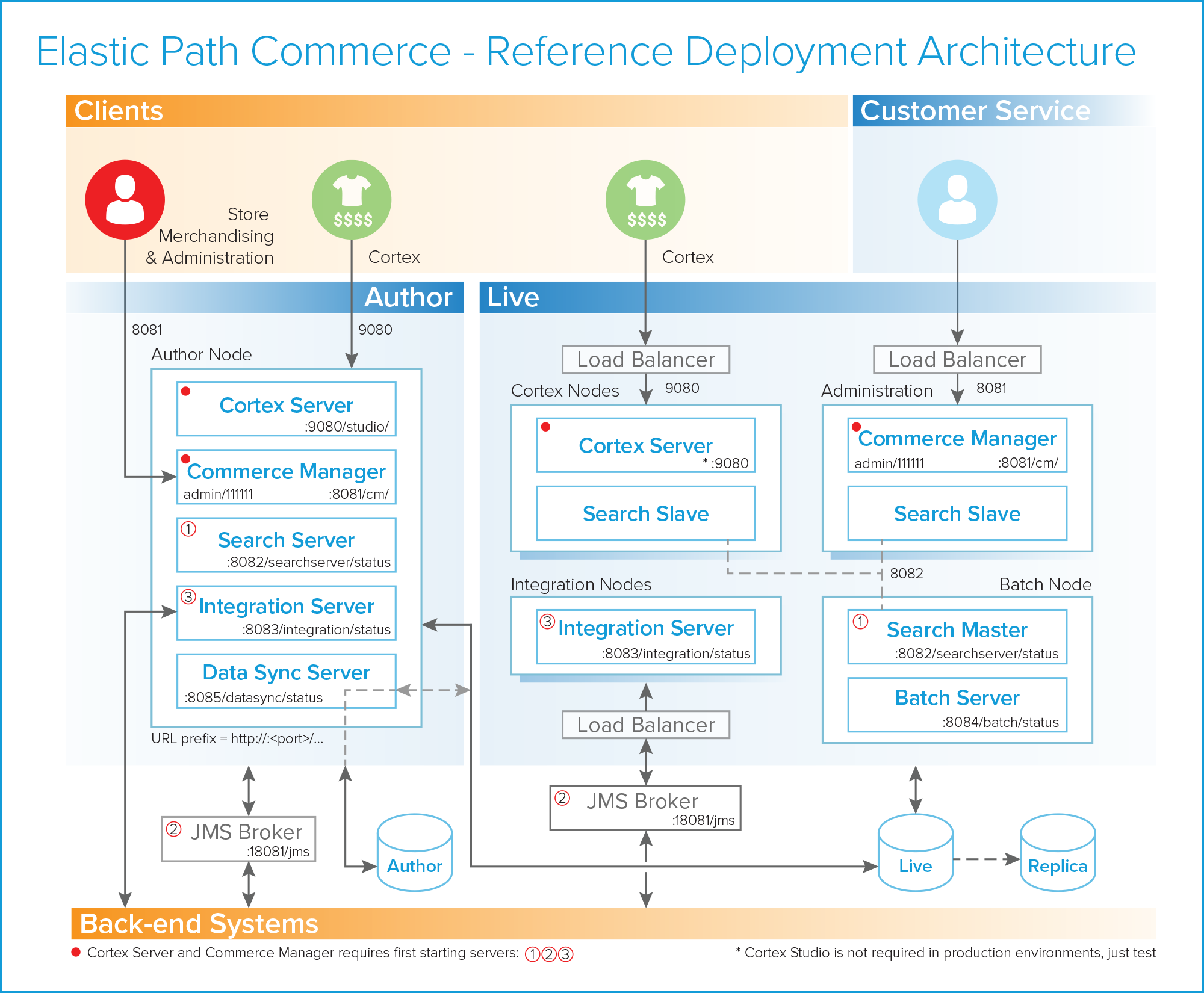
The following deployment diagram represents an example Self-Managed Commerce installation, showing all the components that are supplied and used. Your actual deployment architecture will depend on your organization’s specific requirements for performance, reliability, and scalability.
See Deployment Guidelines for additional information.
System Requirements
Elastic Path provides support if Self-Managed Commerce is deployed on supported platforms, such as certified and compatible platforms.
Certified Platform
Elastic Path products undergo regression and performance testing with certified platforms as part of the release process. These technologies have proven stability and performance and are the recommended configuration for Elastic Path products. Elastic Path’s deployment documentation and performance guides include recommendations and best practices for use of certified platforms with Elastic Path products.
Compatible Platform
Elastic Path products are expected to function correctly when deployed with compatible platforms, but have not undergone testing with such platforms. Elastic Path does not provide recommendations or best practices for these technologies. It is the client’s responsibility to correctly configure and provision these technologies with the associated vendor. Where a compatible platform is used in place of a certified platform, Elastic Path provides application level support and will address issues reported within the core Elastic Path software product. However, Elastic Path has limited ability to triage issues within compatible platforms that cannot be reproduced in a certified platform configuration.
Supported Technologies
Significant changes in the current release are:
- Discontinued
- CentOS 7.6 platform support level changed from Certified to Compatible
- MySQL 5.7 on Amazon RDS support level changed from Certified to Compatible
- New
- Amazon Linux 2 replaces CentOS as a certified platform
Operating Systems (for Application Servers)
| Platform | Support Level | Certified Version |
|---|---|---|
| Amazon Linux | Certified | 2.x |
| CentOS 7.x | Compatible | |
Generic Linux (kernel v4.14-x) | Compatible |
Java
| Platform | Support Level | Certified Version |
|---|---|---|
| Zulu OpenJDK Java 8 | Certified | 8u202 |
| Amazon Corretto 8 | Compatible |
Java Target and Source are 1.8
Application Servers
| Platform | Support Level | Certified Version |
|---|---|---|
| Tomcat 9.0 | Certified | 9.0.16 |
Databases
| Platform | Support Level | Certified Version |
|---|---|---|
| Amazon Aurora RDS (Relational Database Service) (MySQL 5.6-compatible) | Certified | 5.6.10a |
| MySQL 5.7 | Certified | 5.7.28 |
| MySQL 5.7 on Azure Database for MySQL | Certified | 5.7.24 |
| MySQL 5.7 on Amazon RDS | Compatible | |
| Oracle 12c (12.1.0.2) on Amazon RDS | Certified | 12.1.0.2.v3 |
| Oracle 12c (12.1.0.2) | Compatible | |
| Oracle 11g R2 (11.2.0.4) on Amazon RDS | Compatible | |
| Oracle 11g R2 (Enterprise Edition Release) | Compatible | |
| Oracle 11g R2 RAC (Real Application Clusters) | Compatible |
JDBC Driver Versions
| Platform | Supported Driver |
|---|---|
| MySQL 5.7, Amazon Aurora RDS | mysql-connector-java-5.1.44-bin.jar |
| Oracle | ojdbc7-12.1.0.2.0.jar |
Browsers - Self-Managed Commerce Manager
| Platform | Support Level |
|---|---|
| Chrome (latest version) | Certified |
| Internet Explorer 11 (latest version) | Certified |
| Microsoft Edge (latest version) | Certified |
Minimum supported screen resolution is 1366 x 768
Cortex Client Applications
Client applications that communicate with Cortex API must have the following attributes to work with it:
-
The ability to handle all HTTP response codes (not just
200) -
The ability to supply at minimum the following HTTP methods:
GET,PUT,POST,DELETE -
Not make any cross-origin requests to Cortex API
Deployment with CloudOps
The CloudDeploy component in Elastic Path CloudOps for AWS (Amazon Web Services) deploys the deployment package prepared by the CloudTeam component.
CloudDeploy uses the network, Jenkins server, AMIs, and Amazon S3 bucket created by CloudCore. The only infrastructure CloudDeploy creates is:
-
The ECR (Enterprise Container Registry) repositories to store and manage the Docker images that it builds
-
The infrastructure required for a Self-Managed Commerce deployment
This component has Jenkins jobs to build the necessary Docker images and RDS snapshots for deployments. It also has jobs for deploying and updating environments using these Docker images and RDS snapshots.
For more information, see the CloudDeploy section in the Elastic Path CloudOps for AWS documentation.