Search Server Clustering
The EP Search Server provides product discovery (searching and browsing) for Cortex and catalog management for CM. This section provides advice for how to scale a Search Server deployment in a production environment. For staging environments, it is usually sufficient to have a single search primary and no replicas.
Topology
Search Server is implemented using a primary-replica topology. Only a single primary can run at a time, otherwise database conflicts occur updating the TINDEXBUILDSTATUS table.
Two common deployment topologies:
-
Small Deployment Topology
The simplest topology suitable for small deployments is to deploy a Search replica on every Cortex node. Then access Search Server via a
http://localhostURL. -
Large Deployment Topology
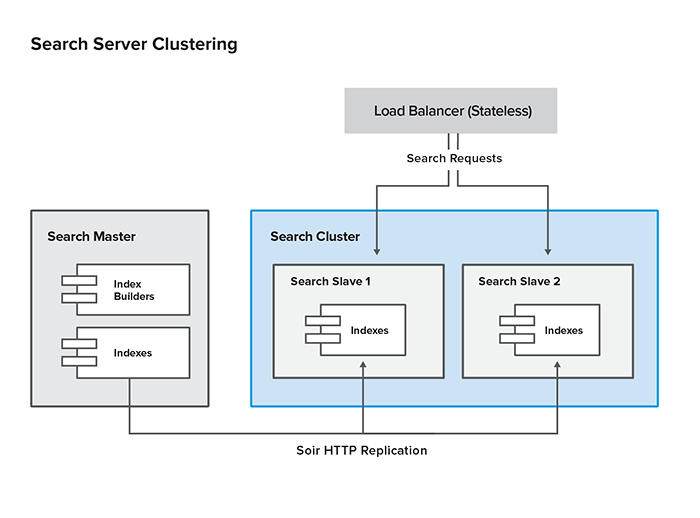
Large deployments typically have a separate cluster of Search replica behind a stateless load balancer. The cluster is accessed via the load balancer URL.
As a starting point, EP recommends deploying one Search replica for every three Cortex servers to support catalog searching and browsing. This ratio may vary depending on the searching and browsing patterns for the store and customizations that change search server usage. A large deployment example is shown below:
Cluster Configuration
The Search primary and replica are deployed using the same WAR file. By default, the WAR is configured to run as a primary node with replication disabled. The steps below configure both primary and replica.
-
Externalize
solrHomedirectory (primary & replica)Move the
solrHomedirectory from the Search WAR to an external location. Elastic Path recommends to include thesolrHomein the deployment package as a separate artifact and then deploy the artifact to the desired location on the server. The benefits of this method are:- You can add replication configuration without invading the WAR
- Search indexes are not deleted when a new WAR is deployed
After
solrHomeis deployed to the desired location, add the following JVM (Java Virtual Machine) parameters to the appserver startup script:-Dsolr.index.dir.category=/home/ep/solrHome/data/index-category-Dsolr.index.dir.cmuser=/home/ep/solrHome/data/index-cmuser-Dsolr.index.dir.customer=/home/ep/solrHome/data/index-customer-Dsolr.index.dir.product=/home/ep/solrHome/data/index-product-Dsolr.index.dir.promotion=/home/ep/solrHome/data/index-promotion-Dsolr.index.dir.shippingservicelevel=/home/ep/solrHome/data/index-shippingservicelevel-Dsolr.index.dir.sku=/home/ep/solrHome/data/index-sku -
Configure primary replication
Each config file in
solrHome/confhas an<xi:include>tag that points to a corresponding replication configuration file.<!-- include primary/replica replication settings --><xi:include href="file:/etc/ep/product.solr.replication.config.xml" xmlns:xi="http://www.w3.org/2001/XInclude"><xi:fallback><!-- Currently this reference is relative to the CWD. As of SOLR 3.1 it will be relative to the current XML file's directory --><xi:include href="../replication/product.solr.replication.config.xml" xmlns:xi="http://www.w3.org/2001/XInclude"><!-- Silent fallback if no external configuration found --><xi:fallback /></xi:include></xi:fallback></xi:include>In this case, Solr first looks for
product.solr.replication.config.xmlin/etc/epand then in the../replicationrelative path.The relative path is relative to where the Search server shell script is run.If necessary, you can change the
<xi:include>block in the Solr config files if/etc/epis not an acceptable location.Here is an example of the
product.solr.replication.config.xmlfile.<requestHandler name="/replication" class="solr.ReplicationHandler"><lst name="master"><!--Replicate on 'startup' and 'commit'. 'optimize' is also a valid value for replicateAfter. --><str name="replicateAfter">startup</str><str name="replicateAfter">commit</str><!-- <str name="replicateAfter">optimize</str> --><!--Create a backup after 'optimize'. Other values can be 'commit', 'startup'. It ispossible to have multiple entries of this config string. Note that this is just for backup,replication does not require this. --><!-- <str name="backupAfter">optimize</str> --><!--If configuration files need to be replicated give the names here, separated by comma --><str name="confFiles">schema.xml,stopwords.txt,elevate.xml</str><!--The default value of reservation is 10 secs.See the documentation below . Normally , youshould not need to specify this --><str name="commitReserveDuration">00:00:10</str></lst></requestHandler>Create separate config files for each index you want replicated. You don’t have to replicate all indexes; just the ones that are actually needed. Here is the full list of config files:
Index Replication Config File Index Used By Category category.solr.replication.config.xmlCortex, CM CM User cmuser.solr.replication.config.xmlCM Customer customer.solr.replication.config.xmlCM Product product.solr.replication.config.xmlCortex, CM Promotion promotion.solr.replication.config.xmlCM SKU sku.solr.replication.config.xmlCM -
For each replication configuration file on the primary, create a corresponding configuration file on the slave. Here is an example of the
product.solr.replication.config.xmlfile:<requestHandler name="/replication" class="solr.ReplicationHandler" ><lst name="slave"><str name="enable">true</str><!--fully qualified url for the replication handler of primary . It is possible to pass on thisas a request param for the fetchindex command--><str name="masterUrl">http://venus.elasticpath.net:8080/searchserver/product/replication</str><!--Interval in which the replica should poll primary .Format is HH:mm:ss . If this is absent replica doesnot poll automatically.But a fetchindex can be triggered from the admin or the http API --><str name="pollInterval">00:00:20</str><!-- THE FOLLOWING PARAMETERS ARE USUALLY NOT REQUIRED--><!--to use compression while transferring the index files. The possible values are internal|externalif the value is 'external' make sure that your primary Solr has the settings to honour theaccept-encoding header.see here for details http://wiki.apache.org/solr/SolrHttpCompressionIf it is 'internal' everything will be taken care of automatically.USE THIS ONLY IF YOUR BANDWIDTH IS LOW . THIS CAN ACTUALLY SLOWDOWN REPLICATION IN A LAN--><str name="compression">internal</str><!--The following values are used when the replica connects to the primary to download the index files.Default values implicitly set as 5000ms and 10000ms respectively. The user DOES NOT need to specifythese unless the bandwidth is extremely low or if there is an extremely high latency--><str name="httpConnTimeout">5000</str><str name="httpReadTimeout">10000</str><!-- If HTTP Basic authentication is enabled on the primary, then the replica can be configuredwith the following<str name="httpBasicAuthUser">username</str><str name="httpBasicAuthPassword">password</str>--></lst></requestHandler> -
Disable indexing on replicas
Add the following line to the
ep.propertiesfile on each replica server to stop the replicas from indexing themselves.ep.search.triggers=disabled -
Enable the Search primary
Add the following line to
ep.propertieson the server containing the search primary to identify which server contains the Search primary.ep.search.requires.master=true -
Configure
searchHostsettingConfigure the search server URLs through the system configuration setting
COMMERCE/SYSTEM/SEARCH/searchHost. You can also use the-Dep.search.default.urland-Dep.search.master.urlJava system properties. The URLs you set depends on your deployment topology.-
Simple topology
In a simple deployment topology, you only need to configure the default value to point to
http://localhost:<port>/<contextPath>/. -
Replica cluster topology
If the search replicas are clustered behind a load balancer, then you need two setting values or Java system properties. The default value identifies the replica cluster and an additional value identifies the search primary.
Setting Context Path Java System Property Value -Dep.search.default.urlURL of the load balancer for the replica cluster master -Dep.search.master.urlURL of the search primary
-
Updating Search Server Cluster
-
Halt any user updates to the system and ensure no changes via the Commerce Manager, Import/Export or Data Sync tool are in progress
-
Ensure the indexing activity is complete for all indexes by checking the indexing status in CM’s Configuration section under Search Indexes.
-
Back up all existing indexes by calling the following links. These links will call the Solr replication API:
http://master_host:port/searchserver/category/replication?command=backuphttp://master_host:port/searchserver/cmuser/replication?command=backuphttp://master_host:port/searchserver/customer/replication?command=backuphttp://master_host:port/searchserver/dynamicContentDelivery/replication?command=backuphttp://master_host:port/searchserver/product/replication?command=backuphttp://master_host:port/searchserver/promotion/replication?command=backuphttp://master_host:port/searchserver/shippingservicelevel/replication?command=backuphttp://master_host:port/searchserver/sku/replication?command=backup -
Disable replication on the replica servers by calling the following links. Make sure this is done for all replicas.
http://slave_host:port/searchserver/category/replication?command=disablepollhttp://slave_host:port/searchserver/cmuser/replication?command=disablepollhttp://slave_host:port/searchserver/customer/replication?command=disablepollhttp://slave_host:port/searchserver/dynamicContentDelivery/replication?command=disablepollhttp://slave_host:port/searchserver/product/replication?command=disablepollhttp://slave_host:port/searchserver/promotion/replication?command=disablepollhttp://slave_host:port/searchserver/shippingservicelevel/replication?command=disablepollhttp://slave_host:port/searchserver/sku/replication?command=disablepoll -
Shut down, update, and restart the primary search server:
- Shut down the application server
- Redeploy the updated search server war
- Restart the application server.
If your search indexes are normally located within the
searchserver/WEB-INFfolder, you may need to restore them from your back up location or do a full rebuild -
Rebuild any indexes that would be affected by the update via the Commerce Manager.
For step-by-step instructions on how to do this, see Requesting Search Index Rebuilds.
-
Verify the primary indexes.
Since the primary server is a full search instance, you can check its state by doing one of the following:
- Issuing manual Solr queries.
- By redirecting Cortex server instance to point to the primary instead of a replica.
-
Do one of the following:
-
If you are applying code updates to the replica servers, do the following for all replicas:
-
Remove the replica from the search cluster
-
Shutdown the server.
-
Redeploy the updated search server war.
-
Restart the server.
The restarted replica will immediately begin polling the primary for index updates on startup.
-
Restore the replica to the search cluster.
-
-
If you are not updating the replica servers, resume index replication by calling the following links for all replicas:
http://slave_host:port/searchserver/category/replication?command=enablepollhttp://slave_host:port/searchserver/cmuser/replication?command=enablepollhttp://slave_host:port/searchserver/customer/replication?command=enablepollhttp://slave_host:port/searchserver/dynamicContentDelivery/replication?command=enablepollhttp://slave_host:port/searchserver/product/replication?command=enablepollhttp://slave_host:port/searchserver/promotion/replication?command=enablepollhttp://slave_host:port/searchserver/shippingservicelevel/replication?command=enablepollhttp://slave_host:port/searchserver/sku/replication?command=enablepoll -
Search Server Cluster Checklist
To verify if your search server cluster is running properly:
- Check if the indexes are being replicated to the replica server
- Ensure requests are being redirected to the replica
- Make sure the update requests are only redirected to the primary server
- Trace requests in the Apache HTTP server’s log and Tomcat server’s access logs
- See if requests are redirected to another server if a server is unavailable